

Machine Learning Training

Efficient start or deep dive into machine learning

as entry-level or advanced AI training

training lasting one or more days

your team, your data and use cases

remote or on site

Request training Request your Machine Learning Training

We are training partners including the following companies:

Perpetuity

Machine learning training for beginners usually lasts one day. Advanced training can usually be booked for a minimum of three days.

Team

We train your team of up to 8 people (or more on request), even with different previous knowledge.

Site

Machine learning trainings are available with us in Cologne & Stuttgart, at your location or remotely in a virtual classroom.

Focus

In our AI training courses, we focused on hands-on with direct practical results. In this way, you will already develop usable results during training.

Beginner or Advanced: Our machine learning training for your AI skills

Whether you're looking for a quick start or are looking for a first deep dive into machine learning: In machine learning training, we teach you everything you need to know about tried and tested machine learning workflows on Databricks at various depths. In this way, you start right where you are and get concrete results for your next steps. Both training variants are hands-on, adaptable to your setup (remote or on-site) and can be carried out with your data if you wish. In this way, we ensure that you can use the AI skills you have learned efficiently in everyday life.
Learn visualizations in Power BI
Learn visualizations in Power BI - taod Academy
Understanding machine learning
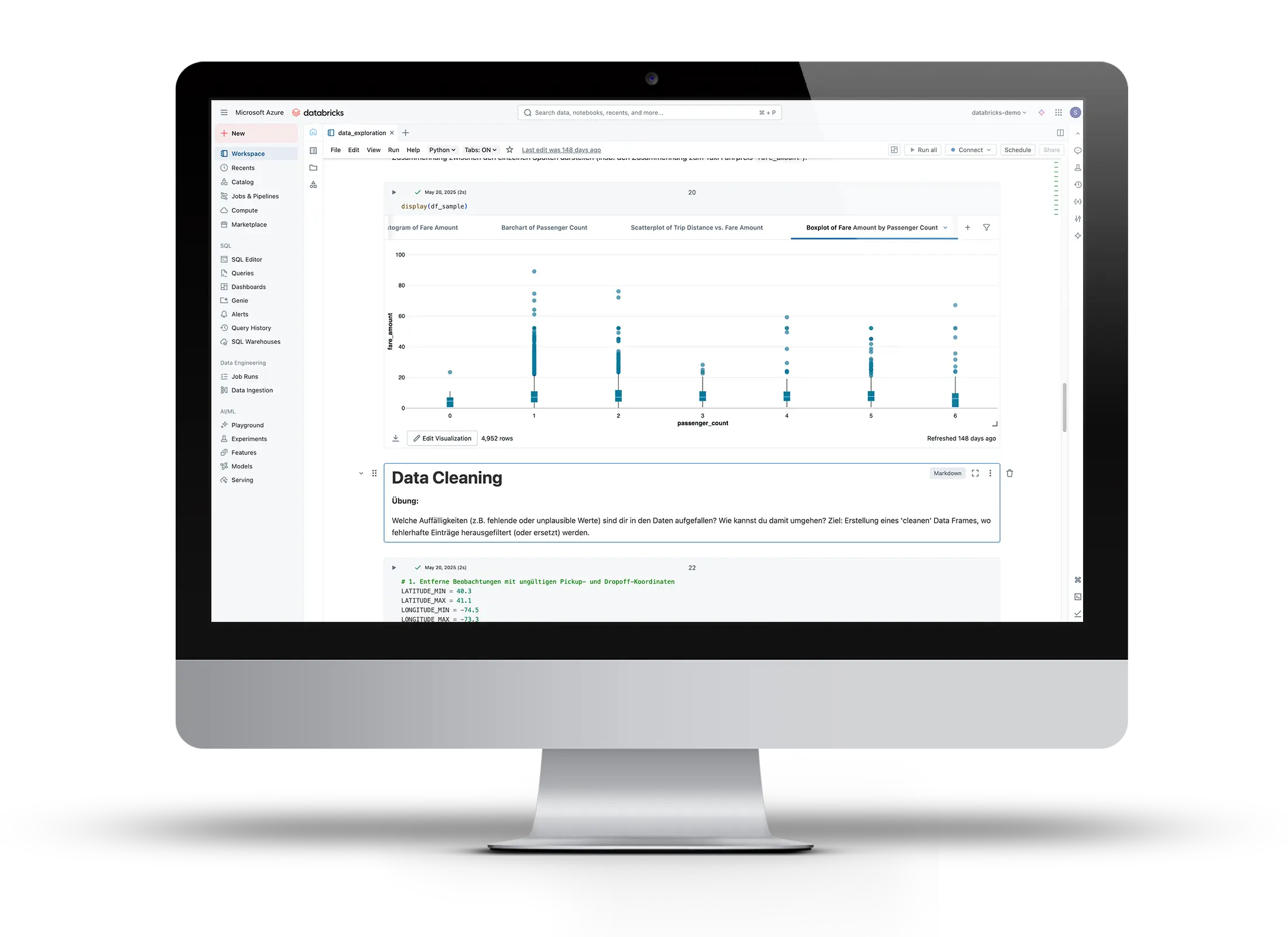
In this machine learning training for beginners, you will learn in practice how to successfully implement machine learning in Databricks: We will guide you through the entire development process — from preparing and analyzing the data to modeling and evaluation. We implement every step together directly in the notebook and record it reproducibly.

You will not only learn the most important concepts of machine learning, but also how to use them concretely and efficiently in Databricks. Previous knowledge of Python or SQL is helpful; we will explain everything else you need for the course in the context of the exercises.
Request you Machine Learning Training

Classic ML vs Generative

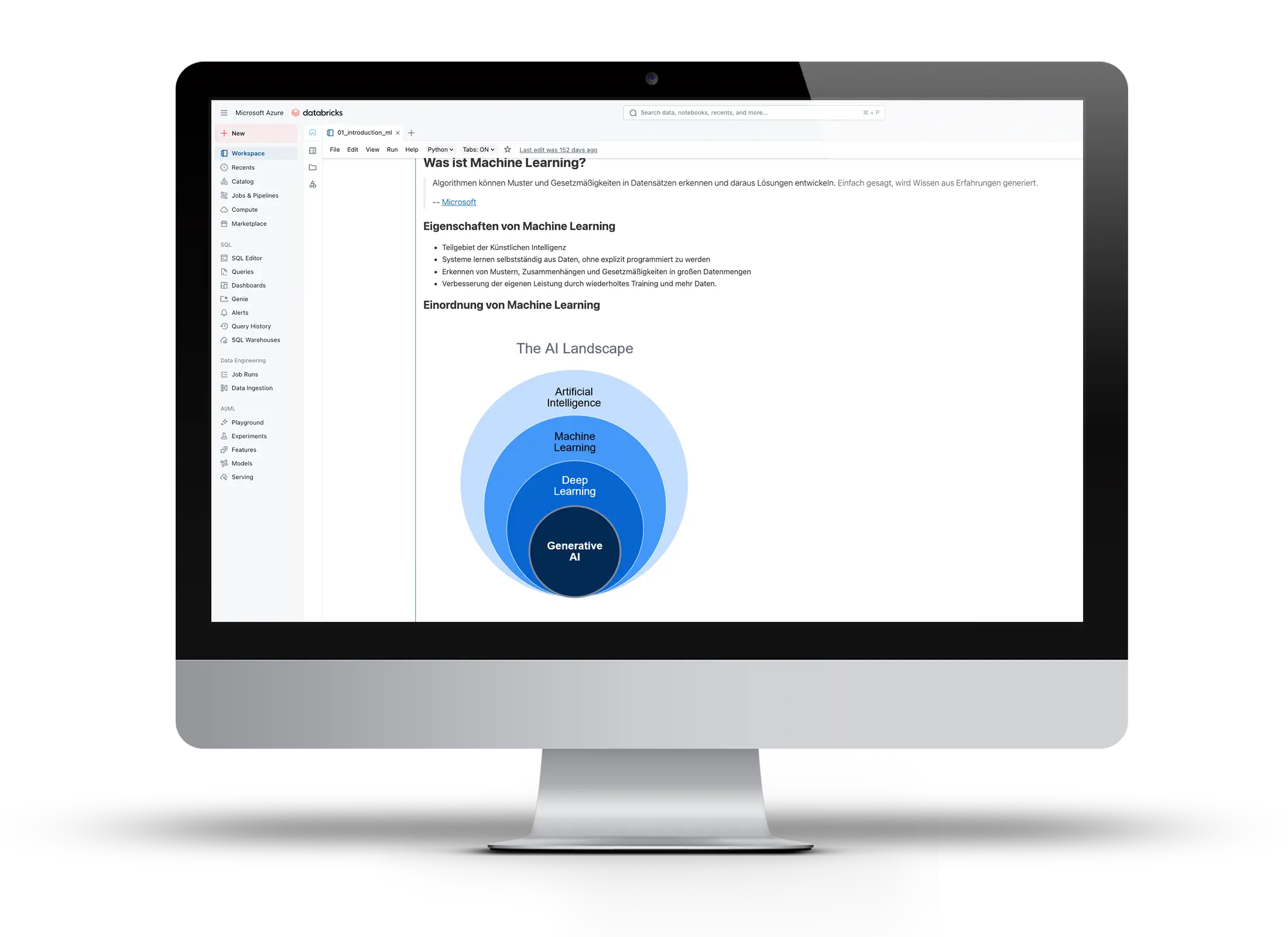
You will learn to clearly separate AI, classic ML and LLMs and to identify suitable use cases.

Databricks basics

We'll introduce you to the key features of Databricks: from workspace and cluster setup to integrated AI/ML features.

Exploratory data analysis with PySpark

You carry out exploratory analyses of a set of practice data: check distributions, make relationships visible and develop initial feature ideas.

Quality check and data cleansing

We'll show you how to identify incorrect values, duplicate entries and outliers and correct them in a targeted manner using established transformation patterns and validation checks.

Model training & evaluation

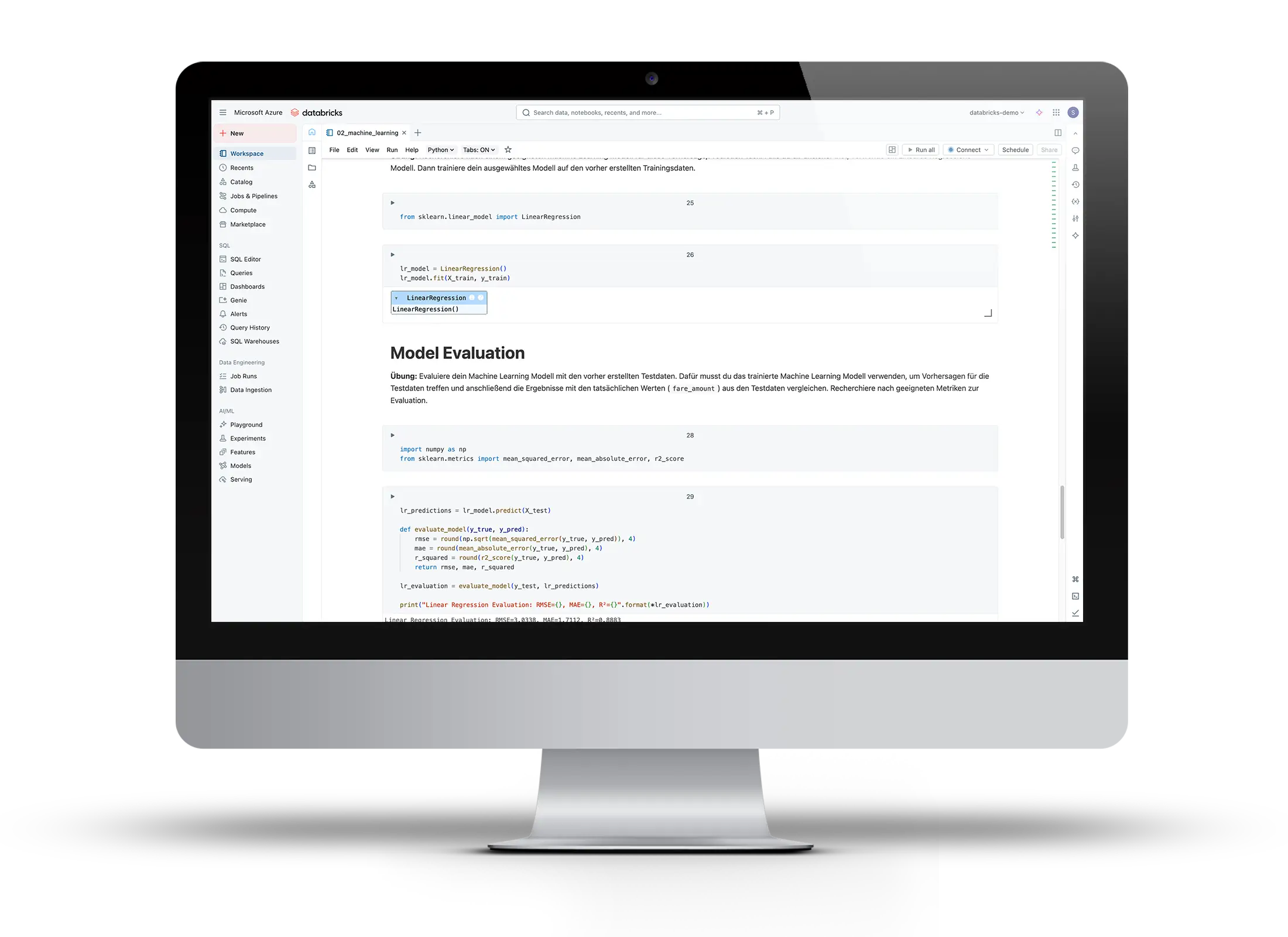
You train a machine-learning model and evaluate its performance using best practices such as train/test splits and cross-validation.
Perfecting machine learning
This training is aimed at teams with machine learning basics and Databricks experience and elevates your work to production levels. The focus is on better model performance (targeted model selection & tuning), clean experiment tracking with MLflow and stable operating routes (deployment & governance).

In this machine learning training, we combine theory with sophisticated hands-on exercises so that you end up with robust, versioned models and a clear operating and monitoring plan. Ideal if you prioritize performance, reproducibility, and operation.
Request machine learning training

Model selection

You choose the appropriate estimator and address under/overfitting in a targeted manner — e.g. with regularization and learning curves.

Hyperparameter tuning (Deep Dive)

Systematic tuning with meaningful search spaces; the focus is on measurable gains compared to the baseline.

MLflow tracking & experiments

You version runs, parameters, metrics, and artifacts; experiments are transparently comparable and reproducible.

Deployment & Governance on Databricks

Batch or real-time? We use Unity Catalog for access, lineage, and compliance.

Challenge or bring-your-own-case

You transfer what you have learned to benchmark or your own data — the result is a clear implementation blueprint.

Meet your coach: Machine Learning from us AI experts!

With us, you will learn best practices directly from our successful customer projects in machine learning training. Because all of our coaches are experienced AI consultants who know exactly what is important when teaching AI skills.
Power BI Coach from taod Academy
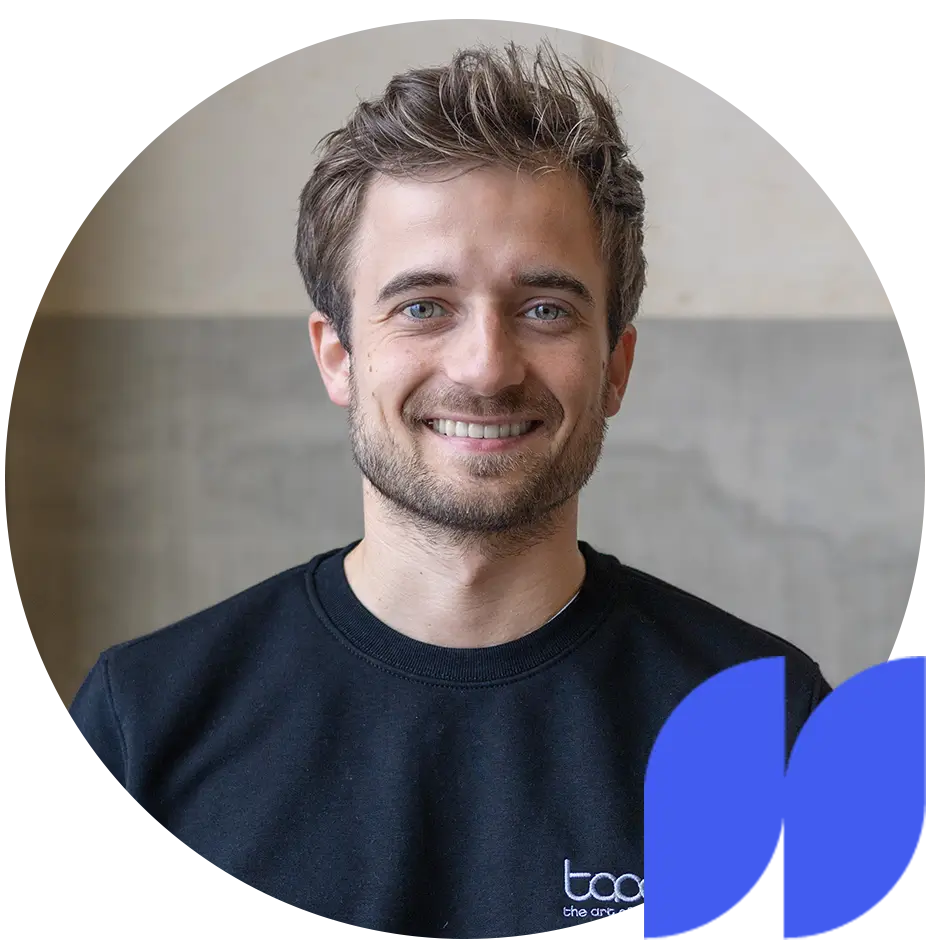
Stefan

Power BI Coach from taod Academy
Christopher

Power BI Coach from taod Academy
Niklas

Power BI Coach from taod Academy
Sven

Power BI Coach from taod Academy
Leonard

Helpful questions (FAQ)

Do I need previous knowledge for machine learning training?

Not necessarily. You can get off to a good start with the entry-level training if you want to understand machine learning in a structured way and apply it in practice. First points of contact with Python or SQL are helpful. We will work out everything else you need for the exercises with you during training.

read more

We'll pick you up right where you're standing right now. In entry-level training, we guide you through the entire development process in Databricks, from data preparation and analysis to modeling and evaluation. If your team already has machine learning basics and Databricks experience, we build on this in Advanced Training and focus specifically on performance, reproducibility and operation.

Can I work with our own data and use cases during training?

Yes, that is exactly what is possible. We tailor the machine learning training to your setup and can work with your own data if you wish. That is not the case with general examples. Instead, you develop results that are closer to your real work context.

read more

We deliberately set up the training in such a way that it fits your questions. To do this, we can integrate our own data, specific use cases or a bring-your-own-case approach. This helps you not to transfer what you have learned later, but to create a reliable basis for the next steps in the project during training.

What do I actually learn in machine learning training?

You will learn how to structure a machine learning workflow cleanly in Databricks. This includes basics, data analysis, data cleansing, feature ideas, model training and evaluation. Depending on the level of training, topics such as MLflow, hyperparameter tuning and deployment are added. This creates a clear path from initial analysis to reliable models.

read more

We not only teach you individual methods, but also a coherent workflow. In the introductory part, we work with Databricks basics, exploratory data analysis with PySpark, quality testing and model evaluation. In advanced training, we specifically deepen model selection, experiment tracking with MLflow, governance, deployment and monitoring so that initial models become production-related solutions.

How does entry-level training differ from advanced training?

The entry-level training helps you get started with machine learning with Databricks in a structured way. Advanced training goes much deeper and is aimed at teams that already have the basics. There, we are working harder on model performance, reproducibility and production-related operating routes. So you're not choosing between theory and practice, but between entry level and deep dive.

read more

We use the entry-level version to build a common understanding and a reliable workflow. In advanced training, we then focus specifically on topics such as under- and overfitting, systematic tuning, versioned experiments, governance and monitoring. The format is therefore suitable both for teams that are just starting out and for teams that want to take their machine learning work to a higher level.

Is machine learning training more hands-on or more theoretical?

The focus is clearly hands-on. During training, you work directly on practical exercises and create results that can be reused. Theory is part of it, but remains closely linked to application. In this way, you not only understand concepts, but also implement them directly.

read more

We value direct practical results and exercises that take place in a realistic workflow. That is why we work together in notebooks, make analyses reproducible and combine methodological principles with concrete steps in Databricks. This is precisely the result of training that not only gives you orientation, but also helps you to implement it more quickly.

How flexible is machine learning training in terms of duration, location and team size?

The training can be adapted quite flexibly to your needs. The entry-level training usually lasts one day, the advanced training usually starts at three days. It is possible remotely, on site or in our rooms. We remain flexible even when it comes to team size, typically up to eight people and even more if required.

read more

We coordinate the duration, format and framework so that they suit your goal and level of knowledge. As a result, compact entry-level training can be just as useful as a multi-day deep dive for an experienced team. At the same time, the setting remains open: We train you remotely in the virtual classroom, at your location or in our locations and tailor the format to your specific setup.